

Quantum Chemistry Acceleration: Comparative Performance Analysis of Modern DFT Implementations
Abstract
This article examines the acceleration of quantum chemistry calculations through modern implementations of Density Functional Theory (DFT). We provide a comparative performance analysis between traditional frameworks and advanced implementations, demonstrating computational efficiency gains. Applications in electrolyte membrane structure analysis illustrate the practical benefits of these performance improvements. Our benchmarking results show how transitioning from traditional implementations to optimized frameworks enables more extensive quantum chemistry simulations within reduced timeframes, with substantial speedups obtained through modern code optimization techniques in Python-based quantum chemistry environments.
1Introduction
Quantum chemistry calculations have become indispensable tools for understanding molecular properties, reaction mechanisms, and material behavior at the atomic scale. Density Functional Theory (DFT) has emerged as one of the most widely used quantum mechanical methods due to its balance between computational efficiency and chemical accuracy. However, as research problems become increasingly complex and systems grow larger, the computational demands of traditional DFT implementations often become prohibitive. Modern scientific computing has witnessed advances in optimization techniques, parallel processing, and algorithmic improvements that directly benefit quantum chemistry calculations. The Python ecosystem, in particular, has seen growth in high-performance scientific libraries that enable researchers to leverage these advances more effectively.
This article presents a performance analysis comparing traditional quantum chemistry frameworks with modern optimized implementations. The development of environmentally-friendly materials for electrochemical applications is crucial for sustainable energy storage and electrolysis technologies. This study focuses on chlorinated analogues of phosphoric acid compounds () as alternatives to fluorinated materials for use in electrochemical systems, aiming to reduce environmental impact while maintaining proton conductivity properties for electrolysis processes. Each test system contains 38 atoms with varying water molecule distributions to simulate realistic chemical environments. Our analysis demonstrates substantial computational speedups obtained through modern code optimization strategies while maintaining chemical accuracy.
2Methods
2.1Target System
Understanding proton exchange membrane structures represents a particularly challenging application for quantum chemistry calculations. The structural analysis involves complex multi-component systems including polymer chains, ionic species, and interfacial interactions. Traditional DFT implementations require substantial computational resources to adequately characterize these structures.
For example, studying environmentally-friendly phosphoric acid structures based on chlorinated analogues of Ogawa et al., 2021, specifically compounds with water molecules, requires calculations on systems containing 38 atoms total with multiple conformational states. The fluorine-to-chlorine substitution aims to develop non-fluorinated materials for environmental sustainability. To investigate proton conductivity properties, several molecules are included in the computational model to simulate realistic proton-conducting environments. Using conventional frameworks like SIESTA Soler et al., 2002, geometry optimization requires substantial computational time on modern computational clusters, making comprehensive structural studies computationally expensive.
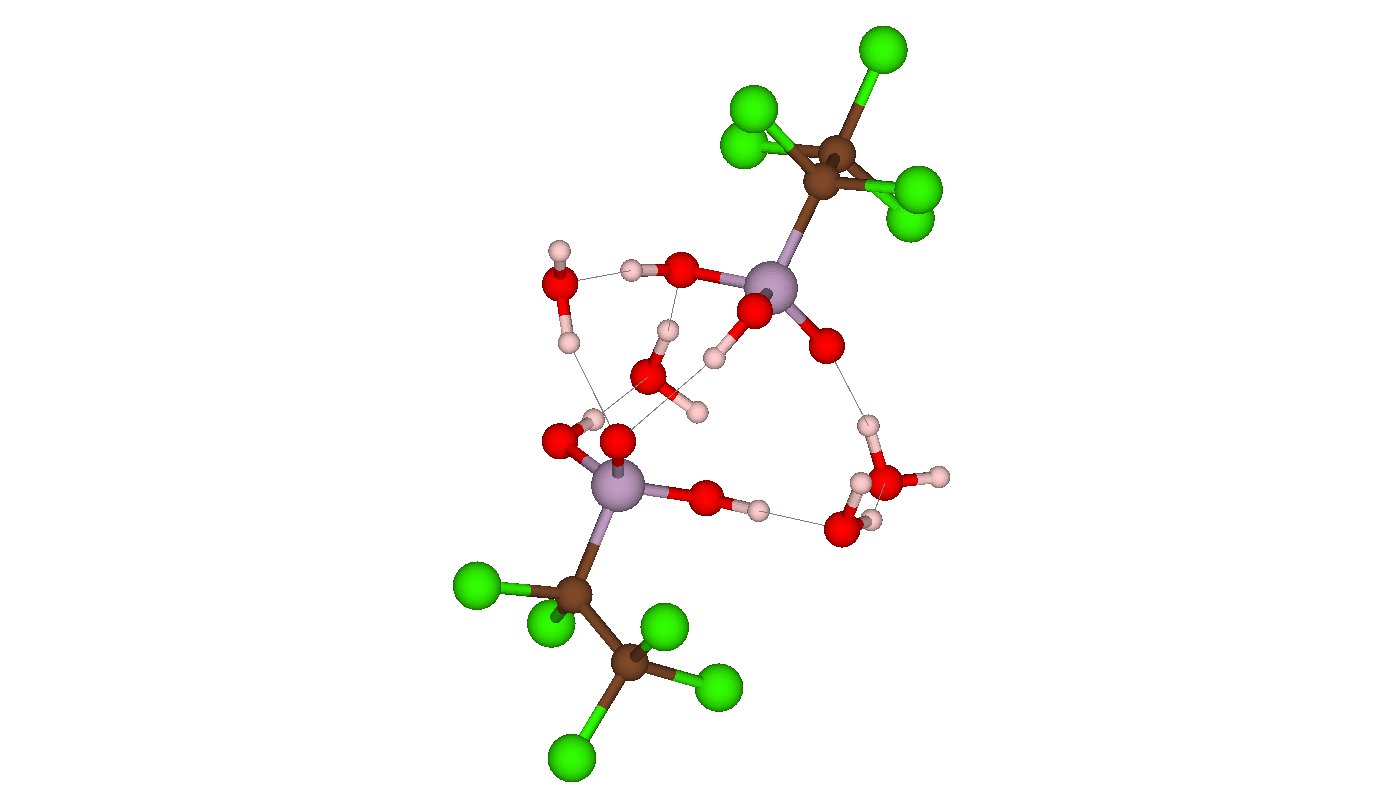
Figure 1:Chemical structure of the compound with molecules studied in this work, showing the chlorinated analogue design for environmental sustainability and proton conduction pathway investigation.
2.2Computational Frameworks
Traditional quantum chemistry frameworks have provided the foundation for decades of molecular modeling research. Packages such as SIESTA have been widely adopted due to their robust implementations and extensive feature sets. However, traditional implementations like SIESTA often present computational bottlenecks when applied to complex systems requiring extensive parameter space exploration. SIESTA remains valuable for specific applications requiring its specialized basis sets, pseudopotentials, or particular exchange-correlation functionals, but may be less optimal for high-throughput studies.
Modern Python-based quantum chemistry environments offer computational advantages through optimized algorithms, efficient memory management, and leveraging of high-performance numerical libraries. Frameworks such as PySCF Sun et al., 2018 and its GPU-accelerated extension GPU4PySCF Wu et al., 2024 have emerged as powerful alternatives that can dramatically reduce computation times while maintaining chemical accuracy. PySCF achieves performance improvements through efficient integral computation algorithms and optimized parallel processing using OpenMP and MPI implementations, while GPU4PySCF further accelerates calculations by leveraging GPU parallelization for computationally intensive operations like two-electron integrals and matrix operations.
3Experimental Conditions
Our benchmarking study compares computational performance across SIESTA, PySCF, and GPU4PySCF implementations using identical test systems. The benchmark suite consists of 85 individual input files, each being a 38-atom system containing a chlorinated phosphoric acid structure () with water molecules. These configurations feature varying water molecule distributions around the phosphoric acid structure to represent different water-membrane configurations, providing realistic system sizes for environmentally-friendly materials design with statistical reliability.
All calculations were performed using identical computational setups to ensure fair comparison:
System: 38-atom systems containing 2 structures with 4 molecules
Exchange-correlation functional: RPBE
Basis set: DZP (Double-Zeta Polarized)
Convergence criteria: SCF tolerance of 10-6 for all calculations
Computational environment:
SIESTA (CPU): 16 parallel jobs (2 cores per job)
PySCF (CPU): 16 parallel jobs (2 cores per job)
GPU4PySCF (GPU): 16 parallel jobs
Hardware:
CPU: Intel Xeon processors, 32 vCPUs, 256 GiB memory (AWS r7i.8xlarge, $2.117/hr)
GPU: 8x NVIDIA A100 80GB SXM4, 240 vCPUs, 1800 GiB RAM (Lambda, $14.32/hr)
Performance metrics: Execution times and costs calculated based on cumulative processing time for all 85 configurations divided by parallelization factor (16) to reflect actual wall-clock time and resource usage
4Results and Discussion
4.1Performance Comparison
Figure 2 shows the performance differences between the three implementations. SIESTA represents the traditional approach with longer execution times, while PySCF provides acceleration through modern optimization techniques. GPU4PySCF shows the best performance by leveraging GPU acceleration, showing improvement in execution time while maintaining lower computational costs. These performance differences enable researchers to conduct more extensive conformational sampling and statistical analysis within available computational resources.
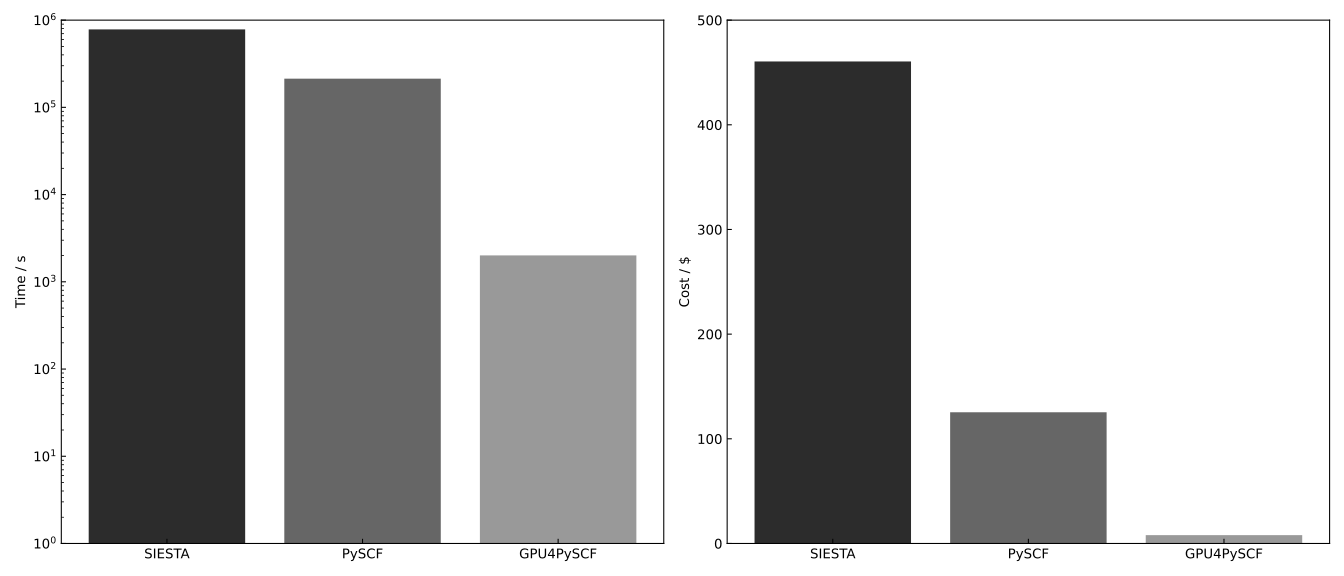
Figure 2:Computational performance comparison between SIESTA, PySCF, and GPU4PySCF for 38-atom systems containing phosphoric acid structures, showing both execution time (left) and computational cost (right).
4.2Impact on Research Methodology
The performance improvements demonstrated in this study have broader implications beyond phosphoric acid structure analysis. The 3.7× speedup observed with PySCF and 390× speedup with GPU4PySCF can be expected to apply to similar molecule systems with comparable atom counts and electronic structure characteristics.
These computational advantages enable:
Expanded parameter space exploration: Systematic investigation of molecular modifications, conformational changes, and environmental conditions across diverse chemical systems through sampling of structural configurations
Enhanced statistical reliability: Larger sample sizes enabling more robust conclusions and confident predictions in materials design studies through increased sampling of molecular configurations and property distributions
Integration with modern workflows: Seamless compatibility with machine learning approaches and automated high-throughput computational screening pipelines, facilitating development of predictive models for materials discovery
The methodology established here provides a foundation for accelerating quantum chemistry calculations across various molecular systems, particularly those involving compounds with heteroatoms (atoms other than carbon and hydrogen) and solvation effects (interactions between solutes and surrounding solvent molecules).
5Conclusions
This study demonstrates computational advantages of modern PySCF implementations over traditional SIESTA for DFT calculations.
Key findings include:
Performance improvement: PySCF shows 3.7× speedup and GPU4PySCF demonstrates 390× speedup compared to SIESTA while maintaining chemical accuracy
Cost efficiency: Computational costs reduced from $460.50 (SIESTA) to $125.35 (PySCF) and $7.99 (GPU4PySCF), representing 73% and 98% cost reductions respectively
Broader applicability: The methodology extends to similar molecular systems, enabling systematic parameter exploration and integration with modern computational workflows
These results provide a foundation for accelerating quantum chemistry calculations across various molecular systems. The demonstrated efficiency gains illustrate the potential for making quantum chemistry calculations more accessible for complex materials science applications.
6Code Availability
The computational scripts, input files, and data processing code used in this study are available at:
https://
The repository includes:
SIESTA, PySCF and GPU4PySCF calculation scripts
85 input configurations for phosphoric acid structures
Data processing and visualization code
Detailed instructions for reproducing the benchmark results
Copyright © 2025 Sahara. This is an open-access article distributed under the terms of the Creative Commons Attribution 4.0 International license, which enables reusers to distribute, remix, adapt, and build upon the material in any medium or format, so long as attribution is given to the creator.
- DFT
- Density Functional Theory
- Ogawa, T., Ohashi, H., Anilkumar, G. M., Tamaki, T., & Yamaguchi, T. (2021). Suitable Acid Groups and Density in Electrolytes to Facilitate Proton Conduction. Physical Chemistry Chemical Physics, 23(41), 23778–23786. 10.1039/D1CP00718A
- Soler, J. M., Artacho, E., Gale, J. D., Garcia, A., Junquera, J., Ordejon, P., & Sanchez-Portal, D. (2002). The SIESTA Method for Ab Initio Order-N Materials Simulation. Journal of Physics: Condensed Matter, 14(11), 2745–2779. 10.1088/0953-8984/14/11/302
- Sun, Q., Berkelbach, T. C., Blunt, N. S., Booth, G. H., Guo, S., Li, Z., Liu, J., McClain, J. D., Sayfutyarova, E. R., Sharma, S., Wouters, S., & Chan, G. K.-L. (2018). PySCF: The Python‐based Simulations of Chemistry Framework. WIREs Computational Molecular Science, 8(1), e1340. 10.1002/wcms.1340
- Wu, X., Sun, Q., Pu, Z., Zheng, T., Ma, W., Yan, W., Yu, X., & others. (2024). Enhancing GPU-Acceleration in the Python-Based Simulations of Chemistry Framework. WIREs Computational Molecular Science. 10.1002/wcms.70008