

Required libraries:
torch
shap
matplotlib
scikit-learn
pandas
numpy
import pandas as pd
import numpy as np
import matplotlib.pyplot as plt
import torch
import torch.nn as nn
import torch.optim as optim
from torch.utils.data import DataLoader, TensorDataset
from sklearn.preprocessing import StandardScaler
from sklearn.metrics import classification_report

import shap
import warnings

warnings.filterwarnings("ignore", category=FutureWarning)1Parameters
# Change this to the path where you have extracted the data
DATA_PATH = "../data/human+activity+recognition+using+smartphones/UCI HAR Dataset"
PLOT_PATH = "../plots"


SEQ_LENGTH = 64
NUM_EPOCHS = 50
BATCH_SIZE = 32
LEARNING_RATE = 1e-3
NUM_SHAP_SAMPLES = 1000
RNG = np.random.default_rng(42)2Load Data
Download the data from the UCI Machine Learning Repository, and extract the files.
x_train = np.loadtxt(f"{DATA_PATH}/train/X_train.txt")
y_train = np.loadtxt(f"{DATA_PATH}/train/y_train.txt")
x_test = np.loadtxt(f"{DATA_PATH}/test/X_test.txt")
y_test = np.loadtxt(f"{DATA_PATH}/test/y_test.txt")
print(f"x_train: {x_train.shape}, y_train: {y_train.shape}")
print(f"x_test: {x_test.shape}, y_test: {y_test.shape}")
x_train: (7352, 561), y_train: (7352,)
x_test: (2947, 561), y_test: (2947,)
features = np.loadtxt(f"{DATA_PATH}/features.txt", dtype=str)
features = features[:, 1]
print("Shape of features: ", features.shape)
Shape of features: (561,)
x_train = pd.DataFrame(x_train, columns=features, dtype=np.float32)
x_test = pd.DataFrame(x_test, columns=features, dtype=np.float32)
x_train.shape, x_test.shape
((7352, 561), (2947, 561))y_train = pd.DataFrame(y_train, columns=["label"], dtype=np.int32)
y_test = pd.DataFrame(y_test, columns=["label"], dtype=np.int32)
y_train.shape, y_test.shape((7352, 1), (2947, 1))NUM_CLASSES = len(np.unique(y_train))
y_train.value_counts()label
6 1407
5 1374
4 1286
1 1226
2 1073
3 986
Name: count, dtype: int64x_train.describe() tBodyAcc-mean()-X tBodyAcc-mean()-Y tBodyAcc-mean()-Z \
count 7352.000000 7352.000000 7352.000000
mean 0.274488 -0.017695 -0.109141
std 0.070261 0.040811 0.056635
min -1.000000 -1.000000 -1.000000
25% 0.262975 -0.024863 -0.120993
50% 0.277193 -0.017219 -0.108676
75% 0.288461 -0.010783 -0.097794
max 1.000000 1.000000 1.000000
tBodyAcc-std()-X tBodyAcc-std()-Y tBodyAcc-std()-Z tBodyAcc-mad()-X \
count 7352.000000 7352.000000 7352.000000 7352.000000
mean -0.605438 -0.510938 -0.604754 -0.630512
std 0.448734 0.502645 0.418687 0.424073
min -1.000000 -0.999873 -1.000000 -1.000000
25% -0.992754 -0.978129 -0.980233 -0.993591
50% -0.946196 -0.851897 -0.859365 -0.950709
75% -0.242813 -0.034231 -0.262415 -0.292680
max 1.000000 0.916238 1.000000 1.000000
tBodyAcc-mad()-Y tBodyAcc-mad()-Z tBodyAcc-max()-X ... \
count 7352.000000 7352.000000 7352.000000 ...
mean -0.526907 -0.606150 -0.468604 ...
std 0.485942 0.414122 0.544547 ...
min -1.000000 -1.000000 -1.000000 ...
25% -0.978162 -0.980251 -0.936219 ...
50% -0.857328 -0.857143 -0.881637 ...
75% -0.066701 -0.265671 -0.017129 ...
max 0.967664 1.000000 1.000000 ...
fBodyBodyGyroJerkMag-meanFreq() fBodyBodyGyroJerkMag-skewness() \
count 7352.000000 7352.000000
mean 0.125293 -0.307009
std 0.250994 0.321011
min -1.000000 -0.995357
25% -0.023692 -0.542602
50% 0.134000 -0.343685
75% 0.289096 -0.126979
max 0.946700 0.989538
fBodyBodyGyroJerkMag-kurtosis() angle(tBodyAccMean,gravity) \
count 7352.000000 7352.000000
mean -0.625294 0.008684
std 0.307584 0.336787
min -0.999765 -0.976580
25% -0.845573 -0.121527
50% -0.711692 0.009509
75% -0.503878 0.150865
max 0.956845 1.000000
angle(tBodyAccJerkMean),gravityMean) angle(tBodyGyroMean,gravityMean) \
count 7352.000000 7352.000000
mean 0.002186 0.008726
std 0.448306 0.608303
min -1.000000 -1.000000
25% -0.289549 -0.482273
50% 0.008943 0.008735
75% 0.292861 0.506187
max 1.000000 0.998702
angle(tBodyGyroJerkMean,gravityMean) angle(X,gravityMean) \
count 7352.000000 7352.000000
mean -0.005981 -0.489547
std 0.477975 0.511807
min -1.000000 -1.000000
25% -0.376341 -0.812065
50% -0.000368 -0.709417
75% 0.359368 -0.509079
max 0.996078 1.000000
angle(Y,gravityMean) angle(Z,gravityMean)
count 7352.000000 7352.000000
mean 0.058593 -0.056515
std 0.297480 0.279122
min -1.000000 -1.000000
25% -0.017885 -0.143414
50% 0.182071 0.003181
75% 0.248353 0.107659
max 0.478157 1.000000
[8 rows x 561 columns]3Preprocess
3.1Zero index the labels
y_train = y_train["label"].apply(lambda x: x - 1)
y_test = y_test["label"].apply(lambda x: x - 1)
y_train.value_counts()
label
5 1407
4 1374
3 1286
0 1226
1 1073
2 986
Name: count, dtype: int643.2Scale data
scaler = StandardScaler()
x_train = scaler.fit_transform(x_train)
x_test = scaler.transform(x_test)
x_train = torch.from_numpy(x_train).float()
y_train = torch.from_numpy(y_train.values).float()
x_test = torch.from_numpy(x_test).float()
y_test = torch.from_numpy(y_test.values).float()3.3Create sliding window sequences
def create_sequences(
    data: torch.Tensor, targets: torch.Tensor, seq_length: int = SEQ_LENGTH
):
    sequences = []
    targets_seq = []
    for i in range(len(data) - seq_length):
        sequences.append(data[i : i + seq_length])
        targets_seq.append(targets[i + seq_length])
    x_seq, y_seq = torch.stack(sequences), torch.stack(targets_seq)
    return x_seq.permute(0, 2, 1), y_seq


x_train_seq, y_train_seq = create_sequences(x_train, y_train, seq_length=SEQ_LENGTH)
x_test_seq, y_test_seq = create_sequences(x_test, y_test, seq_length=SEQ_LENGTH)
from pprint import pprint
pprint(
{
"x_train_seq": x_train_seq.shape,
"y_train_seq": y_train_seq.shape,
"x_test_seq": x_test_seq.shape,
"y_test_seq": y_test_seq.shape,
},
indent=2,
){ 'x_test_seq': torch.Size([2883, 561, 64]),
'x_train_seq': torch.Size([7288, 561, 64]),
'y_test_seq': torch.Size([2883]),
'y_train_seq': torch.Size([7288])}
4Model Definition
class CNNClassifier(nn.Module):
    def __init__(self, input_dim: int, num_classes: int = 6):
        super(CNNClassifier, self).__init__()
        self.layer1 = nn.Sequential(
            nn.Conv1d(input_dim, 32, kernel_size=3, stride=2, padding=1),
            nn.Tanh(),
        )
        self.layer2 = nn.Sequential(
            nn.Conv1d(32, 16, kernel_size=3, stride=2, padding=1),
            nn.Tanh(),
        )
        self.flatten = nn.Flatten()
        self.fc = nn.Linear(256, num_classes)

    def forward(self, x: torch.Tensor) -> torch.Tensor:
        x = self.layer1(x)
        x = self.layer2(x)
        x = x.view(x.size(0), -1)
        x = self.fc(x)
        return x
model = CNNClassifier(input_dim=x_train_seq.shape[1], num_classes=NUM_CLASSES)5Training
5.1Create data loaders
train_ds = TensorDataset(x_train_seq, y_train_seq.long().squeeze())
test_ds = TensorDataset(x_test_seq, y_test_seq.long().squeeze())

train_loader = DataLoader(train_ds, batch_size=BATCH_SIZE, shuffle=False)
test_loader = DataLoader(test_ds, batch_size=BATCH_SIZE, shuffle=False)5.2Define loss function
criterion = nn.CrossEntropyLoss()
optimizer = optim.Adam(model.parameters(), lr=LEARNING_RATE)5.3Train model
for epoch in range(NUM_EPOCHS):
    model.train()
    epoch_loss = 0
    for inputs, labels in train_loader:
        optimizer.zero_grad()
        outputs = model(inputs)
        loss = criterion(outputs, labels)
        loss.backward()
        optimizer.step()
        epoch_loss += loss.item()
    avg_loss = epoch_loss / len(train_loader)
    if epoch % 2 == 0:
        print(f"Epoch [{epoch}/{NUM_EPOCHS}], Loss: {avg_loss:.5f}")
Epoch [0/50], Loss: 0.56563
Epoch [2/50], Loss: 0.32390
Epoch [4/50], Loss: 0.25719
Epoch [6/50], Loss: 0.20879
Epoch [8/50], Loss: 0.17390
Epoch [10/50], Loss: 0.16339
Epoch [12/50], Loss: 0.13955
Epoch [14/50], Loss: 0.13667
Epoch [16/50], Loss: 0.11476
Epoch [18/50], Loss: 0.10730
Epoch [20/50], Loss: 0.12238
Epoch [22/50], Loss: 0.10957
Epoch [24/50], Loss: 0.11315
Epoch [26/50], Loss: 0.09124
Epoch [28/50], Loss: 0.09274
Epoch [30/50], Loss: 0.07581
Epoch [32/50], Loss: 0.06325
Epoch [34/50], Loss: 0.09459
Epoch [36/50], Loss: 0.07064
Epoch [38/50], Loss: 0.07743
Epoch [40/50], Loss: 0.04820
Epoch [42/50], Loss: 0.05792
Epoch [44/50], Loss: 0.04845
Epoch [46/50], Loss: 0.03289
Epoch [48/50], Loss: 0.06304
6Evaluate
with torch.no_grad():
    outputs = model(x_test_seq)
    probabilities = torch.softmax(outputs, dim=1)
    predictions = torch.argmax(probabilities, dim=1)
    # accuracy = ((predicted + 1) == y_test_seq.long().squeeze()).float().mean()
    accuracy = (predictions == y_test_seq.long().squeeze()).float().mean()
    print(f"Test Accuracy: {accuracy.item():.4f}")
Test Accuracy: 0.9084
print(
    classification_report(
        y_test_seq.long().squeeze().numpy(),
        predictions.numpy(),
        target_names=[
            "Walking",
            "Walking Upstairs",
            "Walking Downstairs",
            "Sitting",
            "Standing",
            "Laying",
        ],
    )
)
precision recall f1-score support
Walking 0.96 0.94 0.95 496
Walking Upstairs 0.94 0.93 0.93 471
Walking Downstairs 0.92 0.88 0.90 420
Sitting 0.86 0.83 0.85 467
Standing 0.83 0.92 0.87 501
Laying 0.95 0.94 0.94 528
accuracy 0.91 2883
macro avg 0.91 0.91 0.91 2883
weighted avg 0.91 0.91 0.91 2883
torch.save(model.state_dict(), "../plots/cnn_model.pth")7SHAP Calculations
7.1Create background dataset
def create_balanced_background(
    x_data: torch.Tensor, y_data: torch.Tensor, n_per_class: int = 20
) -> tuple[torch.Tensor, torch.Tensor]:
    """
    Create a balanced background dataset with equal representation from each class.

    Parameters:
    -----------
    x_data : torch.Tensor
        Input features
    y_data : torch.Tensor
        Target labels
    n_per_class : int
        Number of samples to include per class

    Returns:
    --------
    torch.Tensor
        Balanced background dataset
    """
    y_np = y_data.detach().cpu().numpy()
    balanced_indices = []

    for cls in np.arange(NUM_CLASSES):
        cls_indices = np.where(y_np == cls)[0]
        if len(cls_indices) >= n_per_class:
            # If we have enough samples, randomly select n_per_class
            selected_indices = RNG.choice(cls_indices, n_per_class, replace=False)
            # selected_indices = np.random.choice(cls_indices, n_per_class, replace=False)
        else:
            # If not enough samples, use all available with replacement
            selected_indices = RNG.choice(cls_indices, n_per_class, replace=True)
            print(
                f"Warning: Class {cls} has only {len(cls_indices)} samples, using with replacement"
            )
        balanced_indices.extend(selected_indices)

    np.random.shuffle(balanced_indices)
    return x_data[balanced_indices], y_data[balanced_indices]


background_data, background_labels = create_balanced_background(
    x_train_seq, y_train_seq, n_per_class=20
)7.2Calculate SHAP
def calculate_shap_values(
    nn_model: nn.Module,
    background: torch.Tensor,
    test_data: torch.Tensor,
    max_samples: int = 500,
) -> tuple[shap.DeepExplainer, np.ndarray, torch.Tensor]:
    """
    Calculate SHAP values for a CNN model.

    Parameters:
    -----------
    nn_model : torch.nn.Module
        The trained CNN model
    background : torch.Tensor
        Background data for the SHAP explainer (subset of training data)
    test_data : torch.Tensor
        Test data to explain
    max_samples : int
        Maximum number of test samples to explain

    Returns:
    --------
    tuple
        (explainer, shap_values, test_subset)
    """
    nn_model.eval()
    # Limit the number of samples to analyze to avoid memory issues
    test_samples = (
        test_data[:max_samples] if len(test_data) > max_samples else test_data
    )

    print(f"Using {len(background_data)} background samples...")
    expl = shap.DeepExplainer(model, background)

    explanations = expl.shap_values(test_samples)
    print(f"SHAP values shape: {explanations.shape} for {len(test_samples)} samples")

    return expl, explanations, test_samples


# Calculate SHAP values
explainer, shap_values, test_subset = calculate_shap_values(
    model,
    background_data,
    x_test_seq,
    max_samples=NUM_SHAP_SAMPLES,
)
Using 120 background samples...
SHAP values shape: (1000, 561, 64, 6) for 1000 samples
# Save the shap values if needed
np.savez("../plots/shap_values_cnn.npz", shap_values=shap_values)7.3Aggregate SHAP
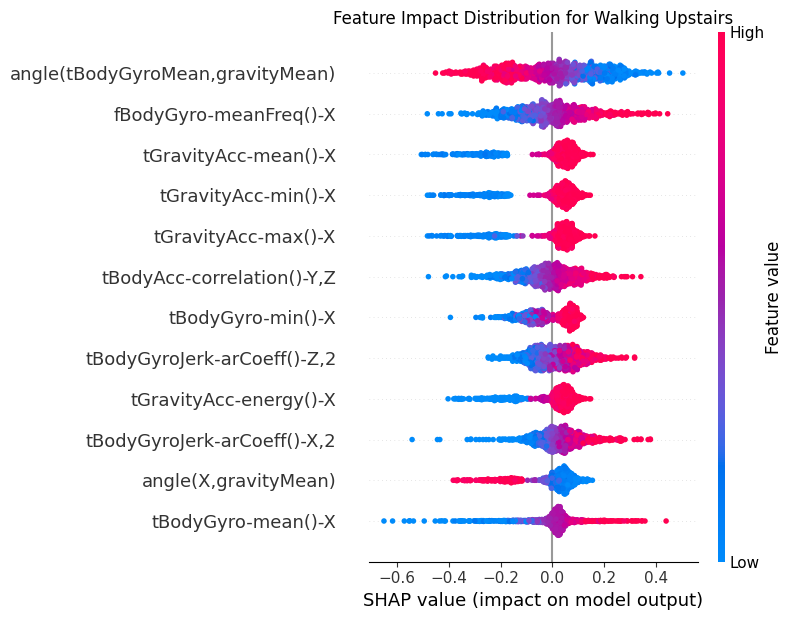
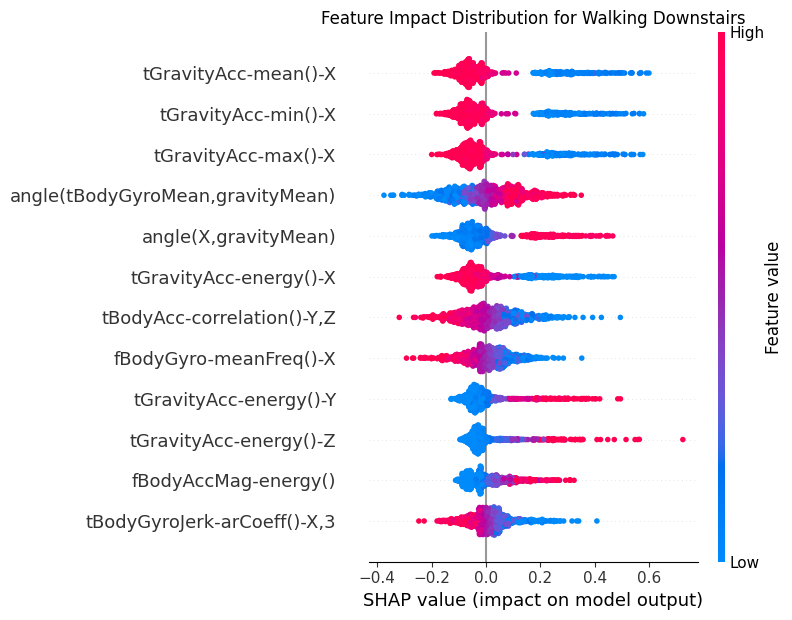
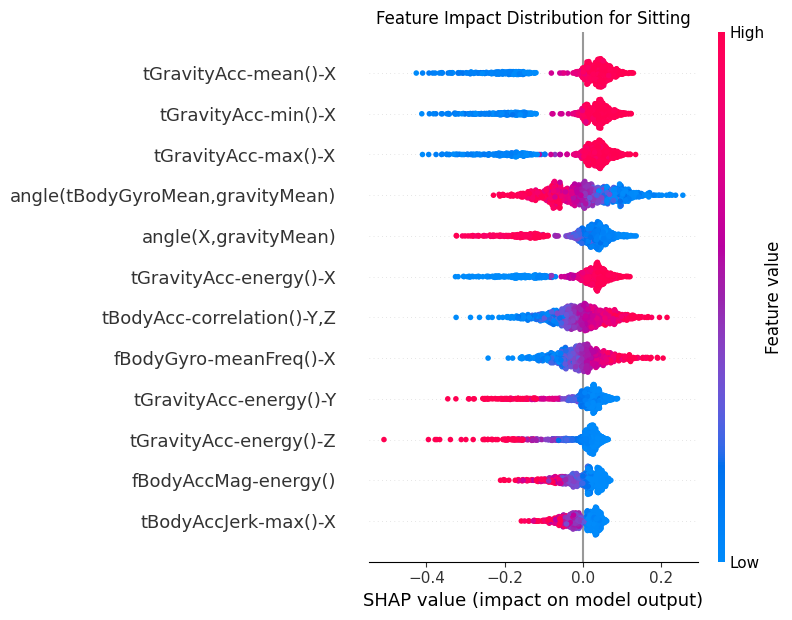
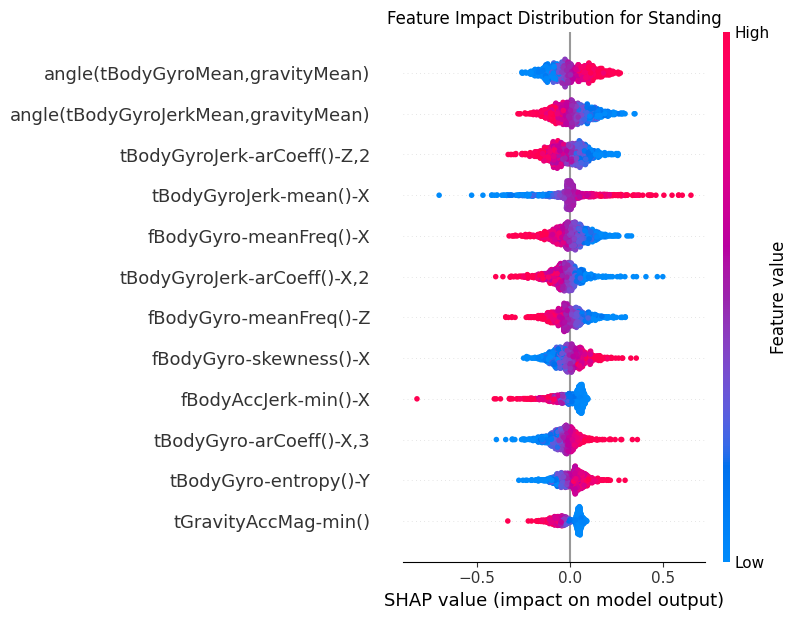
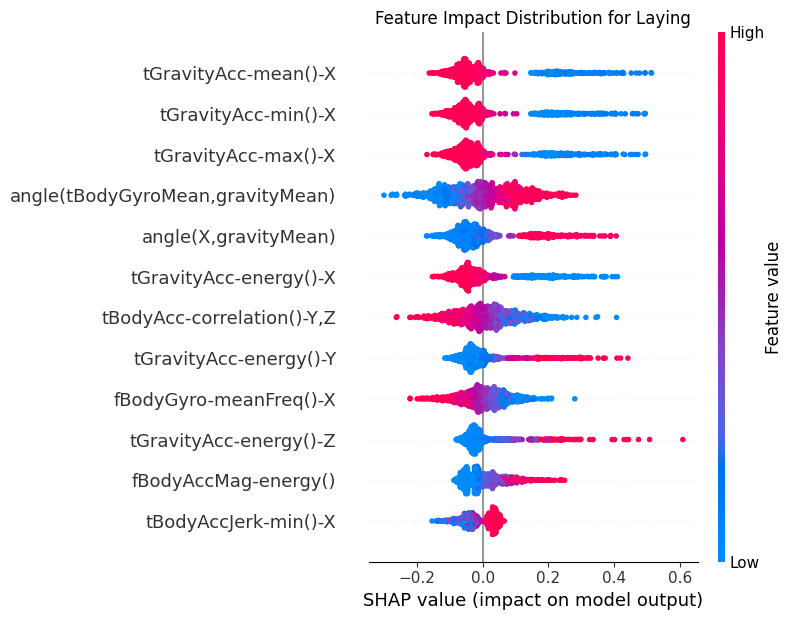
Since we are dealing with a sequence model, we need to aggregate the SHAP values across the sequence length. There are a number of ways to do this. We shall look at the SHAP values for the last time step.
shap_t = shap_values[:, :, -1, :]
print("Shap shape after averaging sequence:", shap_t.shape)
Shap shape after averaging sequence: (1000, 561, 6)
8SHAP Visualizations
shap.initjs()<IPython.core.display.HTML object>CLASS_NAMES = [
"Walking",
"Walking Upstairs",
"Walking Downstairs",
"Sitting",
"Standing",
"Laying",
]8.1Global
for class_idx in range(shap_t.shape[2]):
    class_name = CLASS_NAMES[class_idx]

    # Extract SHAP values for this class
    class_shap = shap_t[:, :, class_idx]

    # Create SHAP Explanation object
    shap_explanation = shap.Explanation(
        values=class_shap,
        base_values=np.zeros(class_shap.shape[0]),
        data=test_subset[:, :, -1].detach().cpu().numpy(),
        feature_names=features.tolist(),
    )

    # Create beeswarm plot
    plt.figure(figsize=(10, 8))
    shap.plots.beeswarm(
        shap_explanation,
        max_display=12,  # Show top 20 features
        show=False,
        order=shap.Explanation.abs.mean(0),  # Order by mean absolute SHAP value
        group_remaining_features=False,
        log_scale=False,
    )
    plt.title(f"Feature Impact Distribution for {class_name}")
    plt.tight_layout()
    _class_name = class_name.replace(" ", "_")
    plt.savefig(f"{PLOT_PATH}/beeswarm_{_class_name}_cnn.png")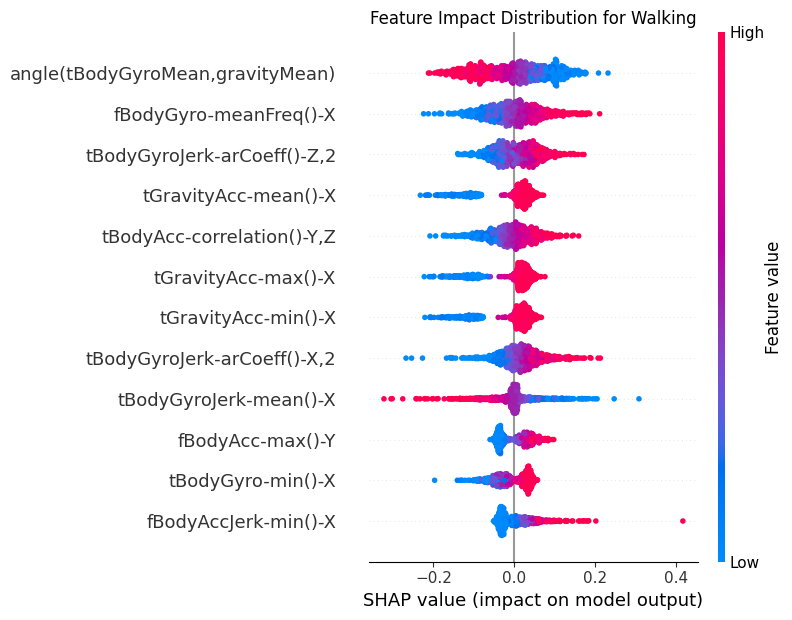
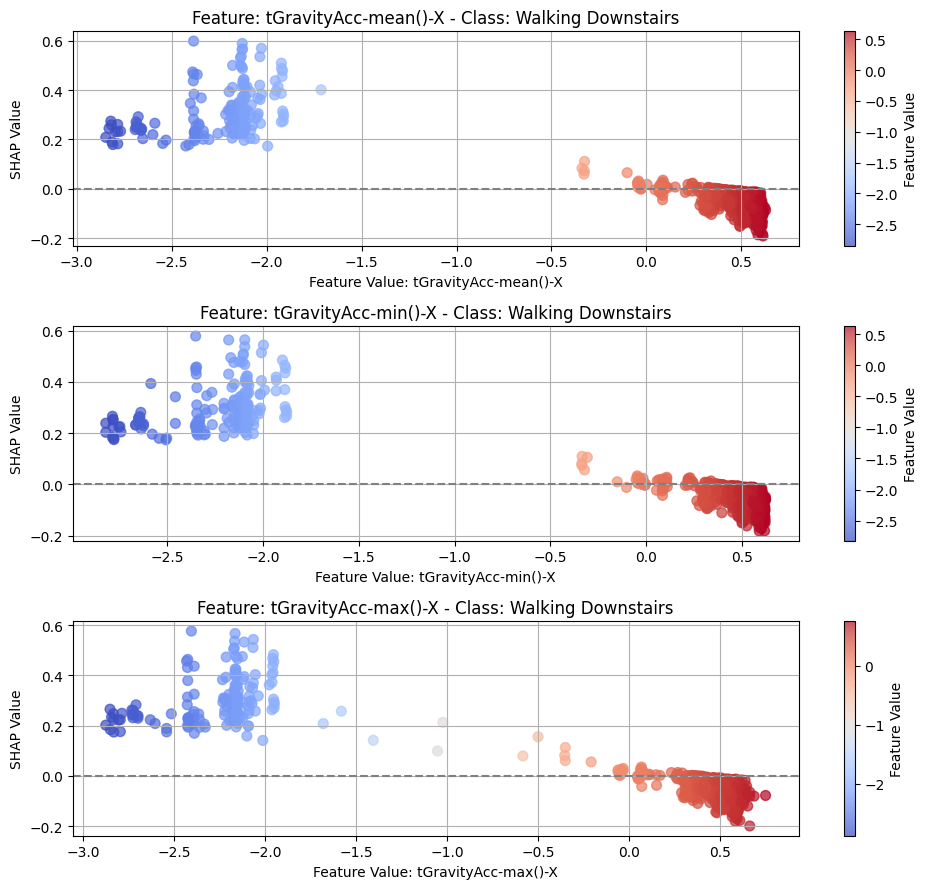
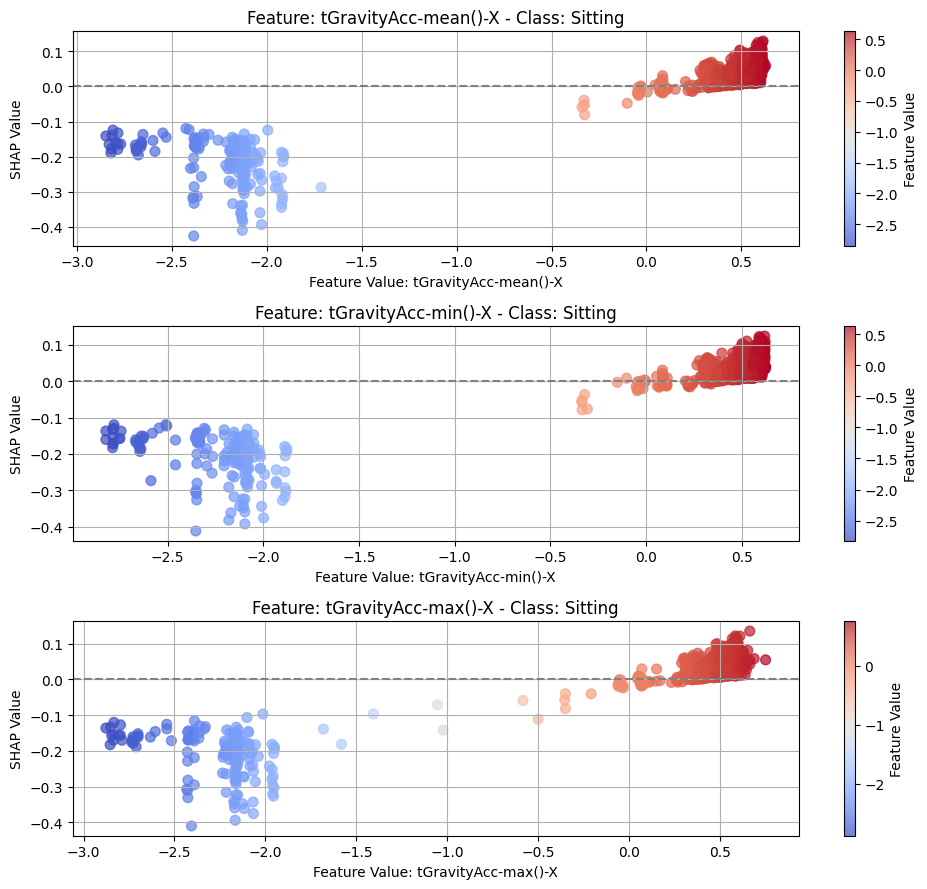
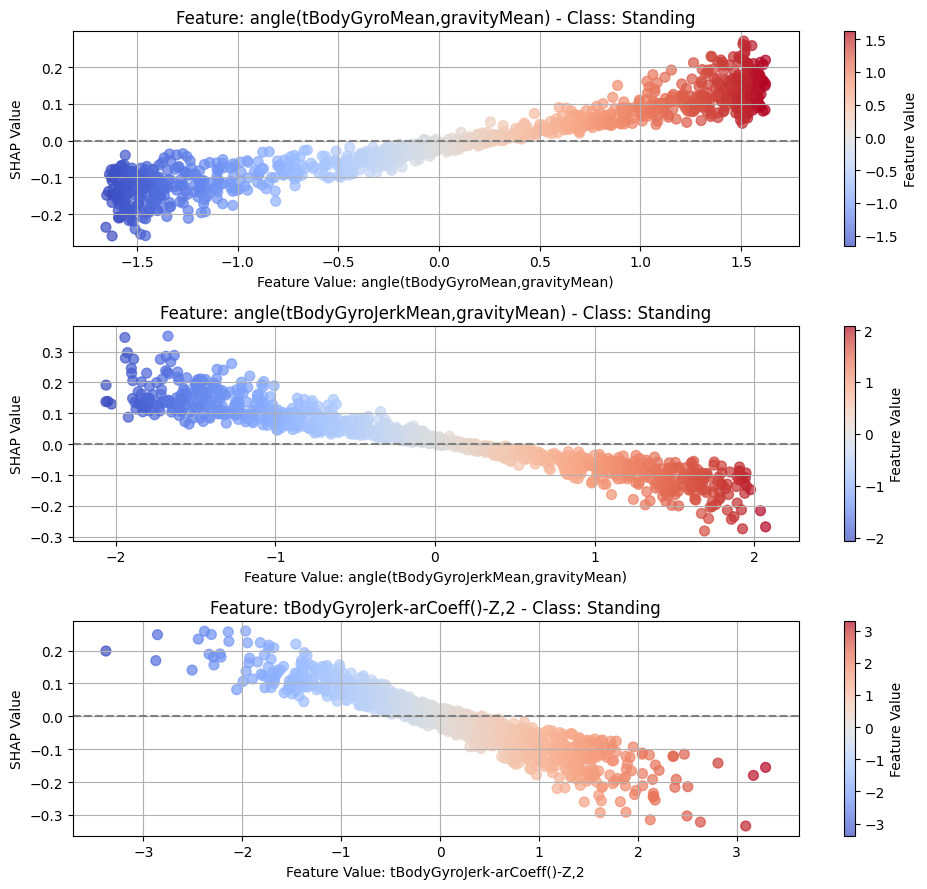
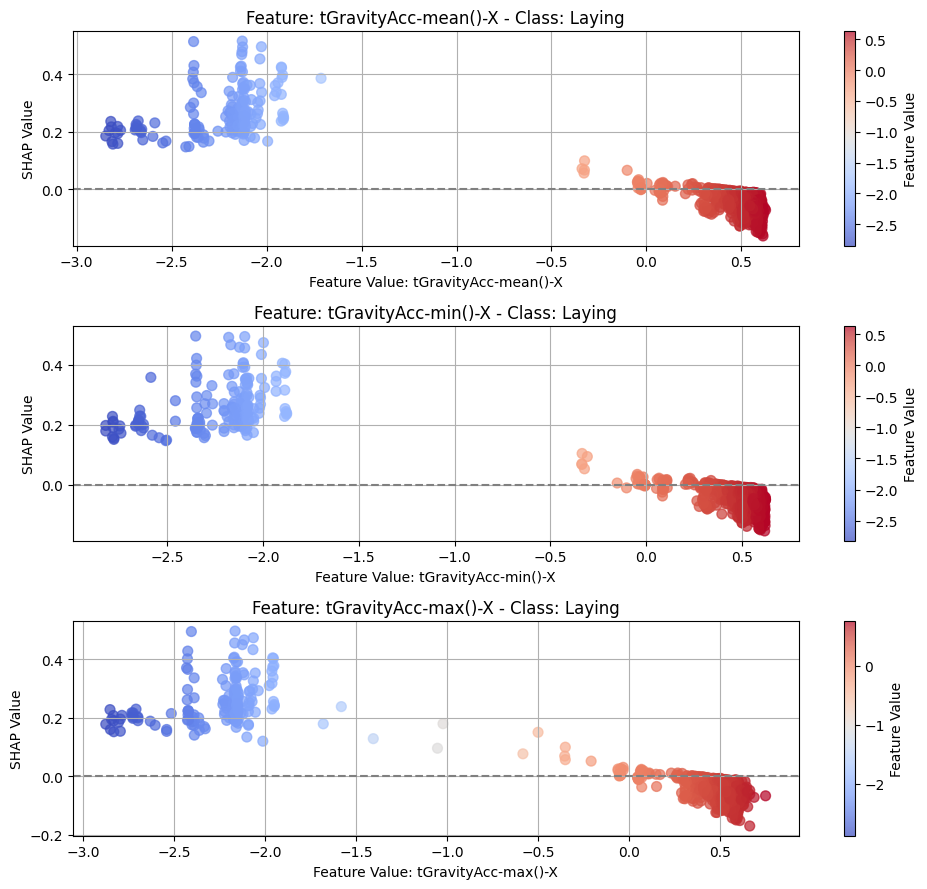
8.2Dependency
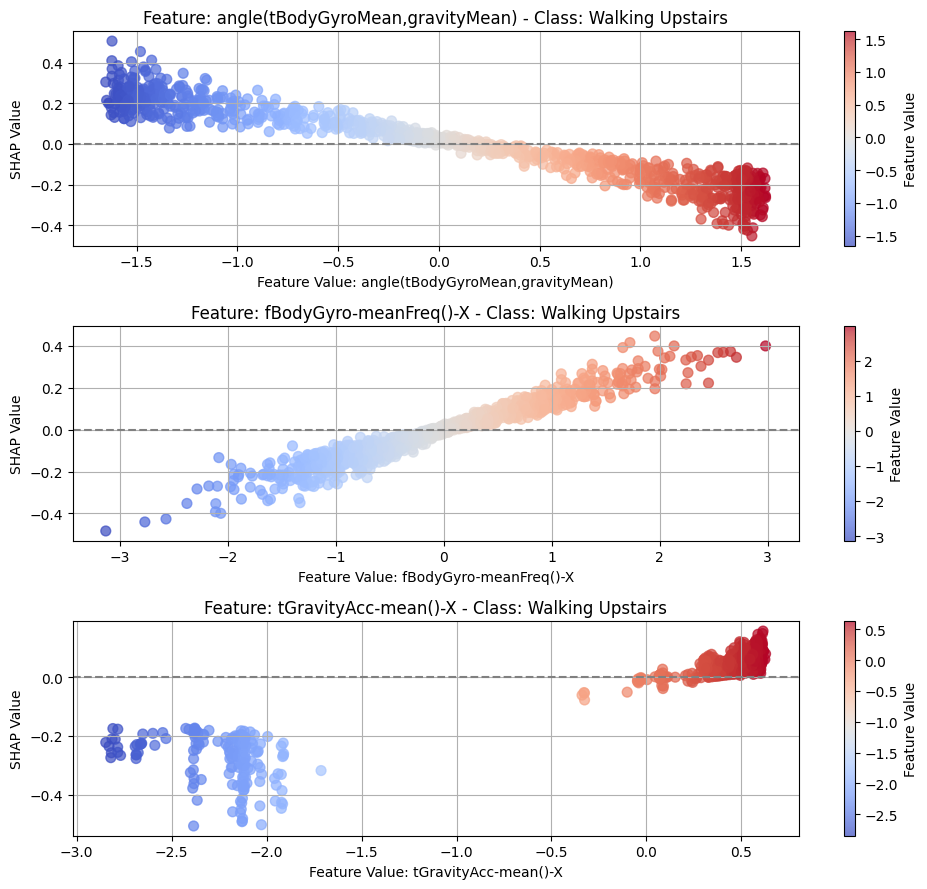
top_n = 3

for class_idx, class_name in enumerate(CLASS_NAMES):
    top_feature_indices = np.argsort(-np.mean(np.abs(shap_t[:, :, class_idx]), axis=0))[
        :top_n
    ]

    fig, axes = plt.subplots(top_n, 1, figsize=(10, 3 * top_n))

    # For each top feature, create subplot
    for idx, feature_idx in enumerate(top_feature_indices):
        ax = axes[idx]

        feature_name = features[feature_idx]
        feature_values = test_subset[:, feature_idx, -1].detach().cpu().numpy()
        shap_values_feature = shap_t[:, feature_idx, class_idx]

        scatter = ax.scatter(
            feature_values,
            shap_values_feature,
            c=feature_values,
            cmap="coolwarm",
            alpha=0.7,
            s=50,
        )

        ax.axhline(y=0, color="gray", linestyle="--")
        ax.set_xlabel(f"Feature Value: {feature_name}")
        ax.set_ylabel("SHAP Value")
        ax.grid(True)
        ax.set_title(f"Feature: {feature_name} - Class: {class_name}")

        cbar = fig.colorbar(scatter, ax=ax)
        cbar.set_label("Feature Value")

    plt.tight_layout()
    _class_name = class_name.replace(" ", "_")
    plt.savefig(f"{PLOT_PATH}/dep_{_class_name}_cnn.png")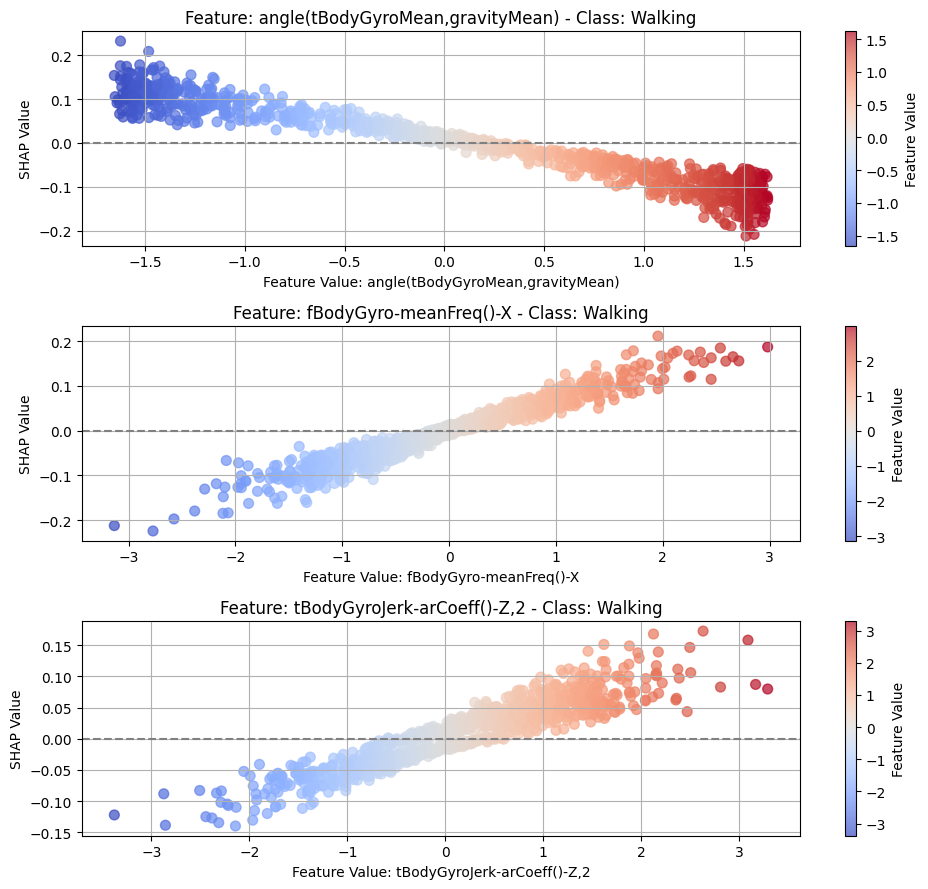
8.3Local
def sample_by_class(y_data: torch.Tensor, class_index: int, n: int = 1) -> np.ndarray:
    """Get sample indices for each class"""
    y_np = y_data.detach().cpu().numpy()
    class_indices = np.where(y_np == class_index)[0]
    return RNG.choice(class_indices, n, replace=False)
def plot_local_shap(
shap_val: np.ndarray, x: torch.Tensor, y: torch.Tensor, class_index: int
) -> None:
"""Plot local SHAP values for a given class and sample"""
x_samples = x[:NUM_SHAP_SAMPLES]
y_samples = y[:NUM_SHAP_SAMPLES]
sample_idx = sample_by_class(y_samples, class_index, n=1)[0]
shap_c = shap_val[:, :, class_index]
expl = shap.Explanation(
values=shap_c,
base_values=np.zeros(shap_c.shape[0]),
data=x_samples[:, :, -1].detach().cpu().numpy(),
feature_names=features.tolist(),
)
plt.clf()
shap.plots.bar(expl[sample_idx], max_display=12, show=False)
cls_name = CLASS_NAMES[class_index].replace(" ", "_")
plt.title(f"Local SHAP Values for {cls_name}")
plt.tight_layout()
plt.savefig(f"{PLOT_PATH}/local_{cls_name}_cnn.png")
plt.show()plot_local_shap(shap_t, x_test_seq, y_test_seq, 0)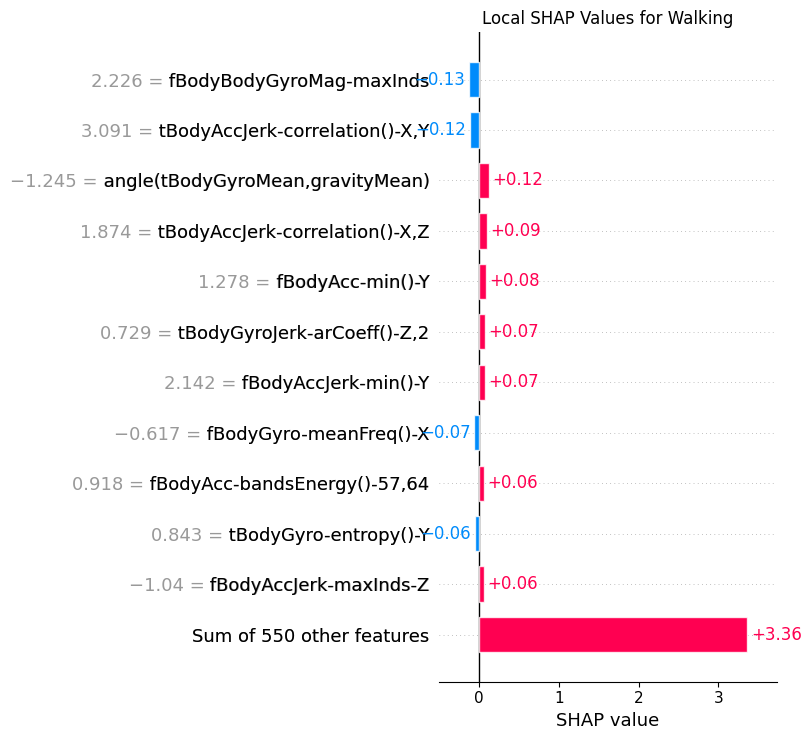
plot_local_shap(shap_t, x_test_seq, y_test_seq, 1)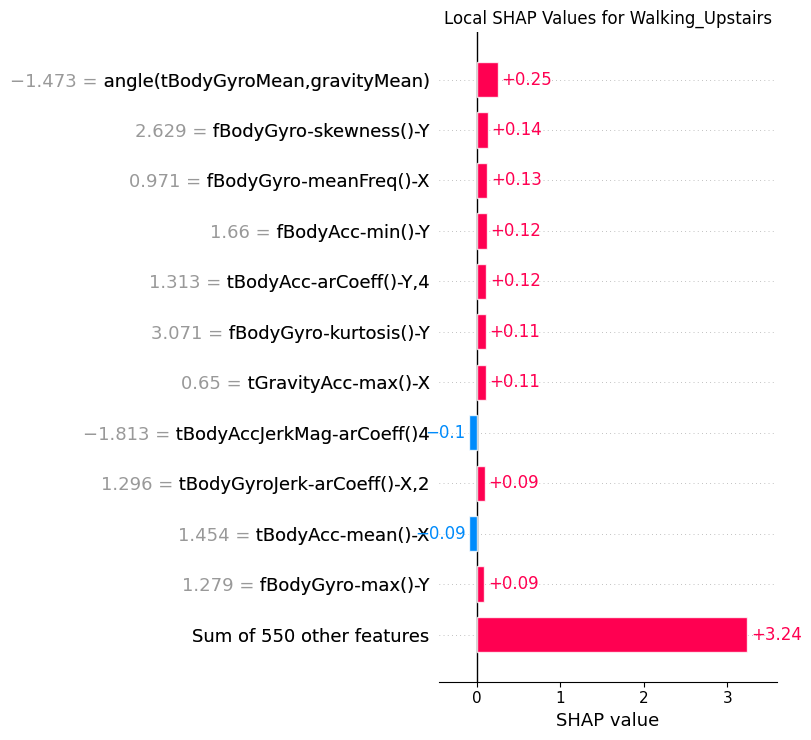
plot_local_shap(shap_t, x_test_seq, y_test_seq, 2)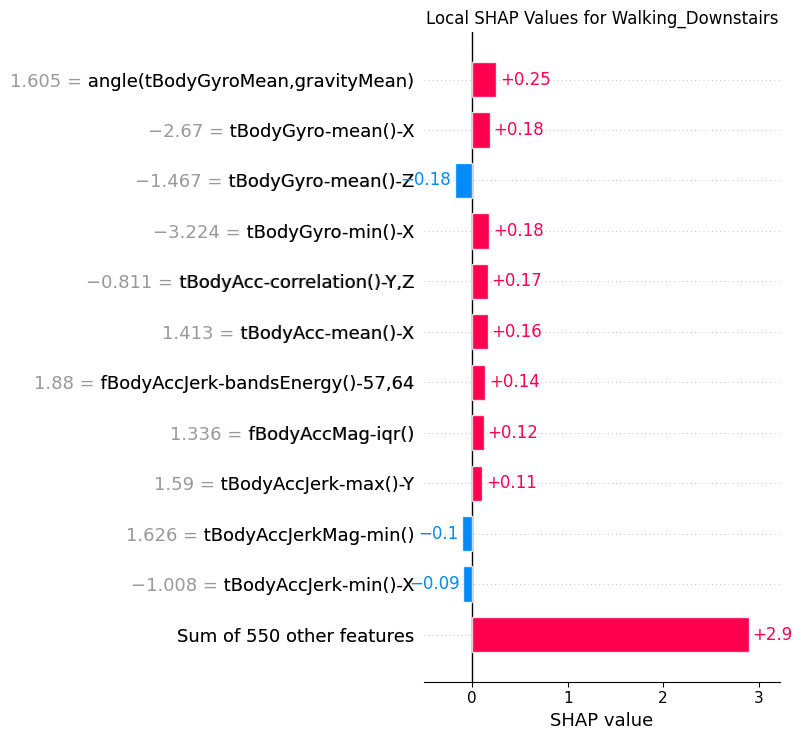
plot_local_shap(shap_t, x_test_seq, y_test_seq, 3)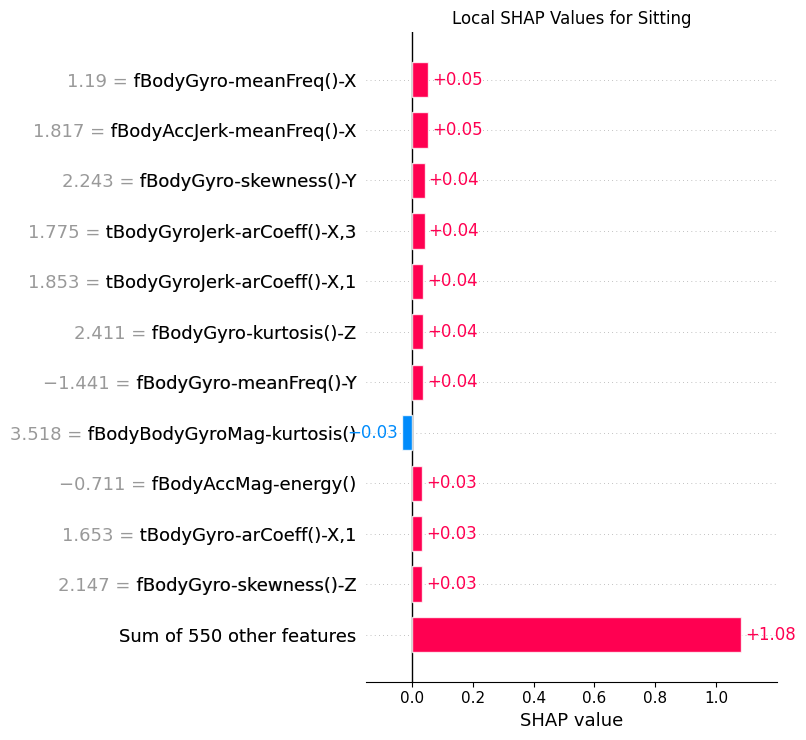
plot_local_shap(shap_t, x_test_seq, y_test_seq, 4)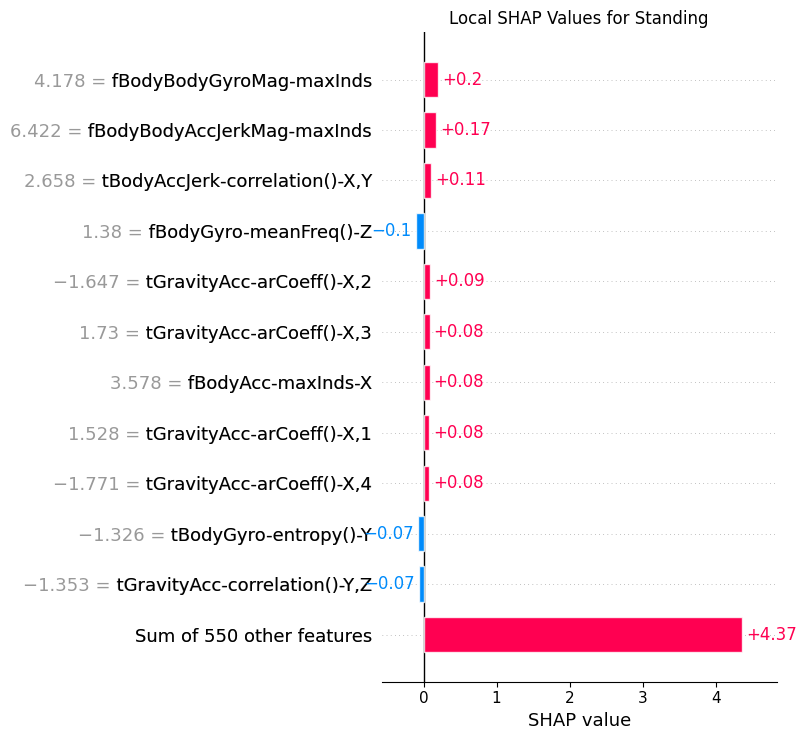
plot_local_shap(shap_t, x_test_seq, y_test_seq, 5)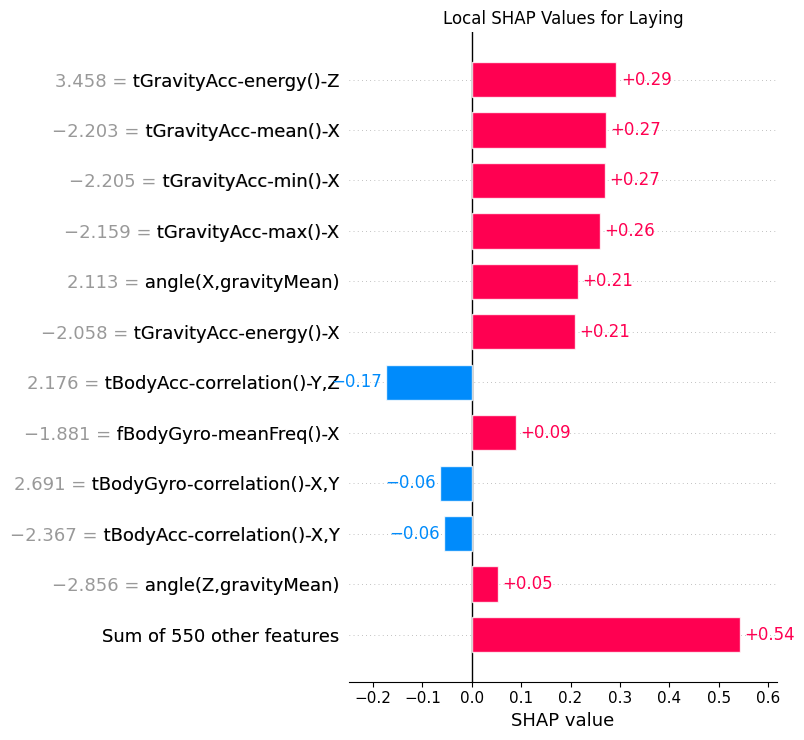
Copyright © 2025 Basu. This is an open-access article distributed under the terms of the Creative Commons Attribution 4.0 International license, which enables reusers to distribute, remix, adapt, and build upon the material in any medium or format, so long as attribution is given to the creator.
- SHAP
- SHapley Additive exPlanations